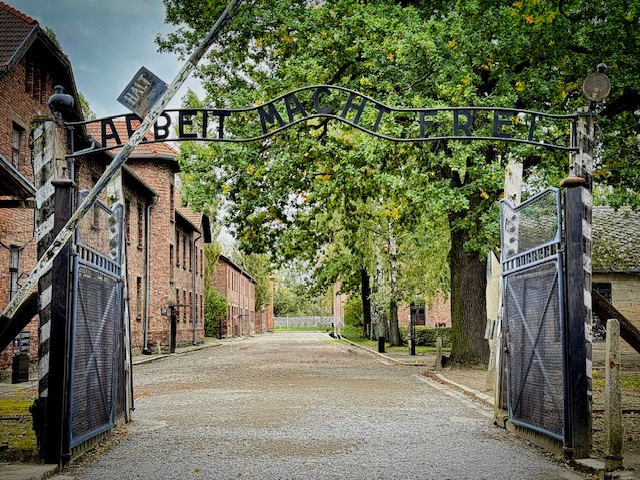
Our recent visit to Auschwitz-Birkenau was one of the most profound experiences our family has ever had. As part of our journey to teach our tween about history, humanity, and empathy, we knew visiting Auschwitz would be an important—but heavy—lesson.
Preparing Our Tween for the Visit
In September, we spent time studying World War II together—reading, watching documentaries, and having open conversations about what happened. Last year, our daughter read The Diary of Anne Frank, and this year we read The Boy with the Striped Pyjamas. Both stories helped her begin to understand the human side of this history—the fear, the loss, and the courage of those who endured it.
Before we went, we talked openly about what Auschwitz-Birkenau was: a place where millions of innocent people suffered and lost their lives during the Holocaust. Before the visit, we talked about how Auschwitz isn’t like a typical museum—it’s a place of remembrance, where silence and respect matter. Together, we explored the emotions she might experience: sadness, confusion, even discomfort, and reassured her that every feeling was valid. She knew she could share her thoughts at any point, and that taking a moment to step away would always be okay.
What to Expect at Auschwitz-Birkenau
Entering the Camp
Walking through the gates with the infamous words “Arbeit Macht Frei” felt surreal. The vastness of the camp, the barracks, the remnants of personal belongings, and the haunting crematoria all speak volumes without words.
Living Conditions
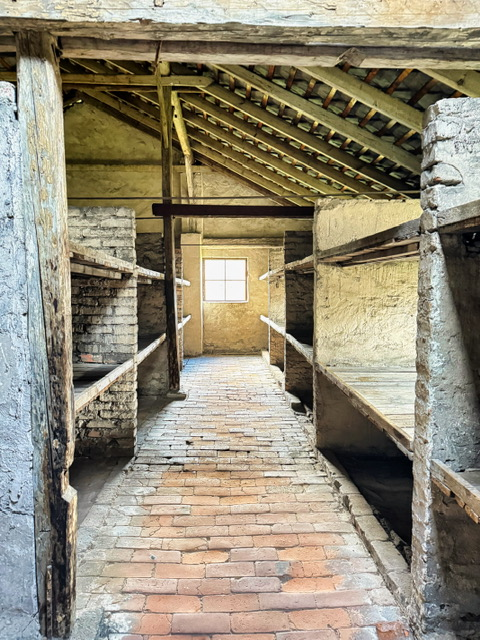
The living conditions were unimaginable—up to 700 people crammed into a single bunker with only eight toilets. Prisoners slept on thin layers of straw, riddled with insects, and the barracks were infested with rats. I can’t even imagine the smell—the mix of unwashed bodies, disease, and decay.
Food and Survival
Nutrition was barely enough to sustain life. Prisoners received three meals a day: in the morning, half a liter of “coffee” (really just boiled water with a grain-based substitute) or an unsweetened herbal tea. For lunch, about a liter of thin soup made from potatoes, rutabaga, and small amounts of groats or rye flour. It was so unappetizing that many new arrivals couldn’t stomach it. Supper consisted of roughly 300 grams of black bread with a small portion—about 25 grams—of sausage, margarine, marmalade, or cheese. The bread was meant to last through the next morning, but hunger often won, and prisoners ate it all at once.
The nutritional value of these meals was extremely low. Combined with brutal physical labor, the body quickly consumed all reserves of fat and muscle. Prisoners grew emaciated, and many developed what was called “starvation sickness.” Those suffering from it were referred to as Musselmen—their bodies and spirits so depleted that they could no longer work and were often selected for the gas chambers. Our guide told us that most people didn’t survive more than six months in the camp.
A Personal Connection
As we walked through, I couldn’t help but think of my father and grandfather. They were placed in a work camp during World War II when my dad was not much older than my daughter is now. It wasn’t Auschwitz—I can’t recall which camp at the moment. I have his registration document packed away at home and will update this post once I find it. I can only wonder if the conditions he endured were anything like what we saw here.
The Most Haunting Rooms
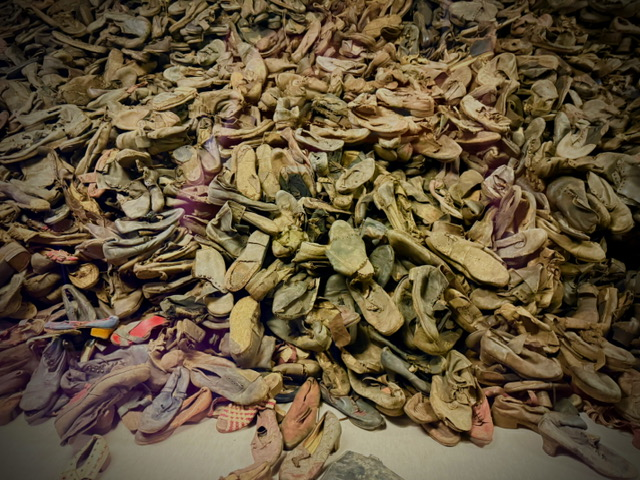
Everything about Auschwitz was horrifying. But two rooms affected me most deeply—the one filled with human hair, and the one with children’s shoes. Standing there, looking at those tiny shoes, I couldn’t fathom how any human could exterminate children and not think twice about it.
The Camp Blocks
Different blocks of the camp reveal different parts of this unimaginable story:
- Block 4: The extermination area, where the process of mass murder is explained in stark, factual displays.
- Block 5: Part of the museum, showing personal belongings—suitcases, glasses, brushes, and those countless shoes.
- Block 10: Where Dr. Josef Mengele and other Nazi doctors conducted medical experiments on prisoners, including children and pregnant women.
- Block 11: Known as “the Death Block,” where prisoners were tortured and punished. Inside are the “standing cells,” each less than one square meter with almost no ventilation. The windows were painted black so others couldn’t see what was happening. Many prisoners from Block 11 were taken outside to the Death Wall and shot.
Gas Chamber and Crematorium 1
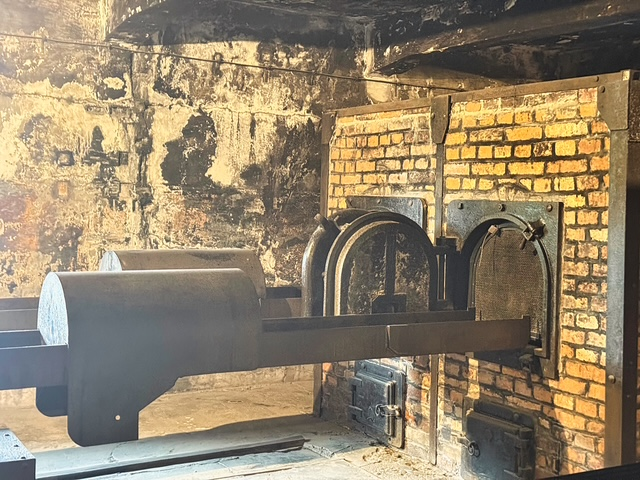
We also visited Gas Chamber and Crematorium I, which was disguised as a communal shower. The SS deceived those fated to die, telling them they were being sent for disinfection and a bath. After undressing, the victims were led into the chamber, the doors were locked, and they were killed with Zyklon B gas.
Afterward, Sonderkommando prisoners—those forced to work under unimaginable horror—were made to remove the bodies. They had to cut the women’s hair and extract any metal dental work or jewelry. The corpses were then burned in pits, on open pyres, or in the crematorium furnaces. Until September 1942, some victims were buried in mass graves. Later, even those bodies were exhumed and burned to erase evidence of the crimes.
Crematorium I had limited capacity and was mainly used when there was a need to kill smaller numbers of people. Its furnaces could originally burn around 200 bodies a day. After a third furnace was added, that number rose to about 340 per day. At the height of operations—when all of the gas chambers at Birkenau were functioning—the Nazis were burning up to 8,000 bodies daily. Hearing that number from our guide made time stop. It’s beyond comprehension—the scale of cruelty, the mechanization of death.
Birkenau – The Scale of Atrocity
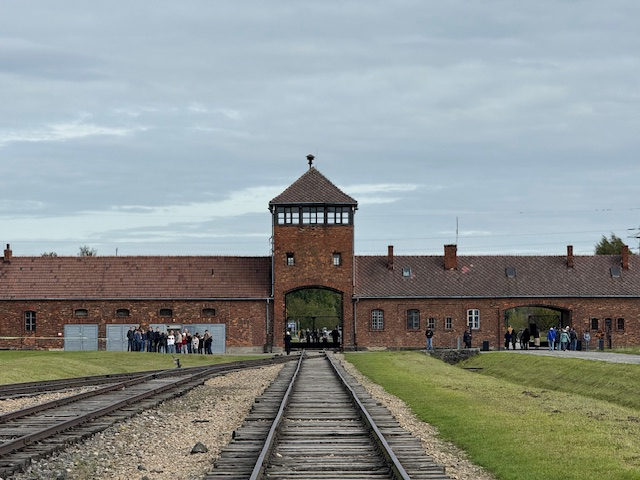
When we moved to Birkenau (Auschwitz II), the enormity of the site was staggering—stretching roughly 2 km across. You see the endless rows of barracks and the ruins of the gas chambers and crematoria, destroyed by the Nazis before liberation. Then your eyes follow the train tracks—the same ones that brought people directly into the camp.
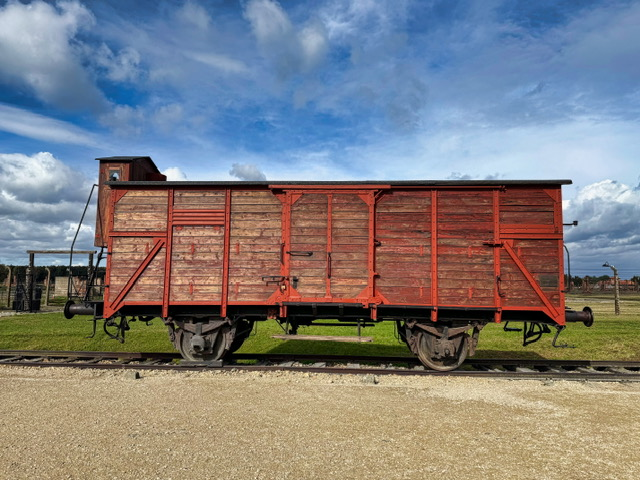
Beside those tracks sits an original train car, a haunting reminder of the transports that arrived here. Up to 80 people were crammed inside each car—men, women, and children—without food, water, or toilets for days. Some of the elderly or already sick died before even arriving. Upon disembarking, new arrivals were immediately sorted. Those deemed fit for labor were sent into the camp, while the very young, the old, and the weak were sent straight to the gas chambers.
Standing there, imagining those moments of chaos and fear, it was hard to breathe. Our guide’s voice was calm but heavy as he explained that people often believed they were being relocated for work, right up until the very end.
Processing the Visit
Our tween was quiet for most of the visit, visibly moved. We checked in often, and while she found it difficult, she understood the importance of bearing witness. For us as parents, seeing her absorb this painful history was both heartbreaking and powerful.
| Tips for Visiting Auschwitz-Birkenau with Kids or Teens 🕊️ Prepare Ahead: Talk about the history in advance. Use books or documentaries appropriate for their age. 🕊️ Set Expectations: Let them know it will be an emotional experience, not a typical sightseeing trip. 🕊️ Allow Space: Give them permission to take breaks or step away if needed. 🕊️ Encourage Questions: Be ready to answer with sensitivity. 🕊️ Reflect Afterward: Talk about what you saw and how it made you feel. This helps process the experience. 🕊️ Respect the Site: Emphasize the importance of silence and respect throughout the visit. |
Why We Think It’s Important
We believe that exposing children to history in this honest and direct way helps build empathy and a deeper understanding of humanity’s capacity for both cruelty and resilience. Auschwitz-Birkenau is a place that teaches us the importance of standing against hate, discrimination, and injustice.
Getting to Auschwitz-Birkenau from Kraków
Auschwitz-Birkenau is located about 70 km (roughly 1.5 hours) from Kraków, in the town of Oświęcim. We drove there ourselves, which was straightforward, and parking was available near the entrance.
If you don’t have a car, there are regular trains and buses from Kraków to Oświęcim, or you can book a transport + guided tour package that includes pickup from the city.
It’s important to know that you can’t just show up and enter — visits must be booked in advance through the official Auschwitz Museum website. Most visitors join a guided tour, as access without one is limited to certain hours. The guides provide valuable historical context that helps you understand not just what you’re seeing, but the human stories behind it.
If you’d like a more convenient option, you can also book a tour with transport from Kraków — this can simplify the logistics and ensure your time slot is confirmed.
The Syp’s Survival Summary: Carrying the Weight Forward
Visiting Auschwitz-Birkenau with our tween was one of the heaviest experiences we’ve faced as a family. It’s not a place you just “survive” — it’s a place that stays with you long after you leave. We left carrying the weight of history, sorrow, and the reminder of what happens when hatred goes unchecked.
But through that heaviness came a powerful lesson: the importance of remembrance, empathy, and standing up for kindness every day. It was challenging to guide our child through such a profound experience, but we believe it was vital.
If you’re planning a visit with your family, prepare your hearts and minds. This is a journey not only through a place but through human resilience and the call to never forget.
Some links here are affiliate links. If you buy something, I might earn a small commission—thanks for supporting my blog! I only share products I use and stand behind.
Comments
3 responses to “Visiting Auschwitz-Birkenau with Our Tween: An Important, Heavy Lesson”
Auschwitz/Birkenau is a very difficult place to visit, as Venesa writes. I went years ago with my husband, my aunt and uncle drove us there, but they would not go in. Once was enough for them
I’m really glad we went, but I feel the same — it’s not a place I could easily return to. Visiting once was powerful enough to stay with me.
Wow! I can’t even imagine the weight of it all being there but I think it’s so important and vital to teach our kids all about it.