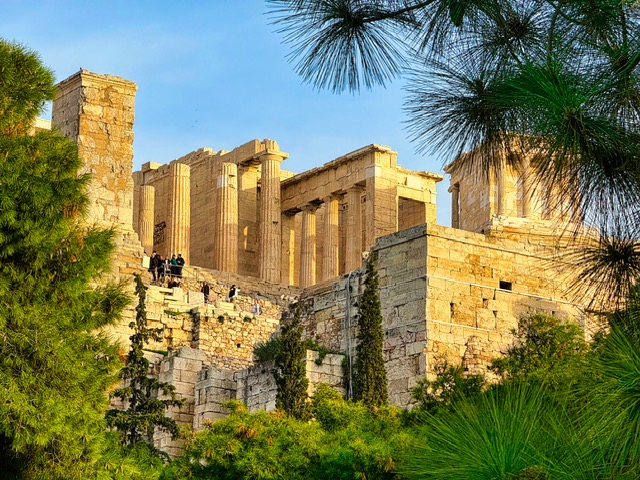
If there is one thing you should see in Athens—one hill to climb, one place to break a light sweat while pretending you’re totally fine—it’s the Acropolis. No contest. No runner-up. Just thousands of years of history casually sitting above a modern city, daring you not to be impressed.
And yes, we were impressed. Very impressed. Add in fewer crowds than peak summer, and it felt like the Acropolis was showing off without trying too hard—and winning effortlessly.
Some links here are affiliate links. If you buy something, I might earn a small commission—thanks for supporting my blog! I only share products I use and stand behind.
What Is the Acropolis, Anyway?
The Acropolis is a rocky hill rising above Athens, used since ancient times as a sacred and defensive site. The word itself means “high city.” Think of it as ancient Athens’ VIP section—reserved for gods, temples, and architecture that refuses to be ignored even 2,500 years later.
At the top, you’ll find several major ruins, each with its own purpose and personality:
The Parthenon (a.k.a. The Parthenon)
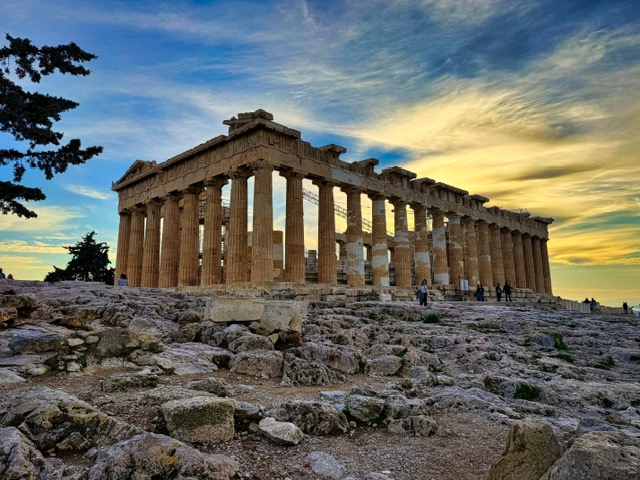
Let’s start with the celebrity.
The Parthenon is the most famous building on the Acropolis, dedicated to Athena, the goddess of wisdom and warfare (and apparently city-planning). Built in the 5th century BCE, it once housed a massive statue of Athena made of gold and ivory. Today, what remains is still breathtaking—perfectly imperfect columns, subtle curves engineered to fool the human eye, and an undeniable “wow” factor.
Now, because we are THAT nerdy, we’ve been watching all of the My Big Fat Greek Wedding movies while in Greece. So when the Parthenon inevitably comes up in conversation, our daughter actually gets the reference. Somewhere, Toula would be proud.
The Propylaea
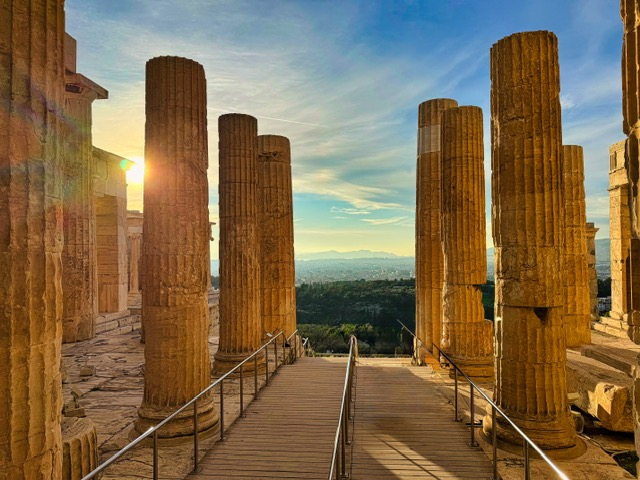
This was the grand entrance to the Acropolis. Basically ancient Athens saying, “Welcome, but make it dramatic.” Even in ruins, you can tell this was designed to impress before you even reached the main temples.
The Erechtheion & The Caryatids
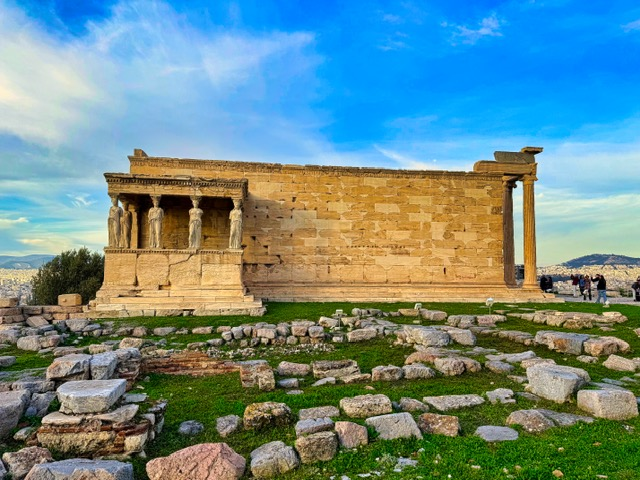
One of the most unique buildings on the Acropolis, the Erechtheion is famous for its Caryatids—six sculpted female figures used as columns. The originals are now safely in museums, but even the replicas are stunning. Elegant, haunting, and somehow still holding the roof after centuries.
The Temple of Athena Nike
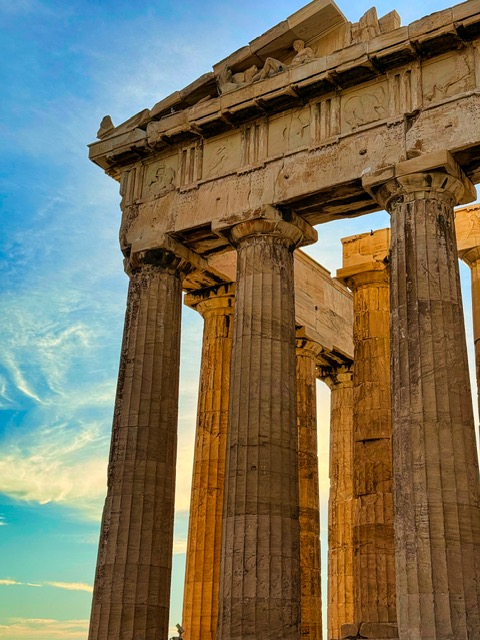
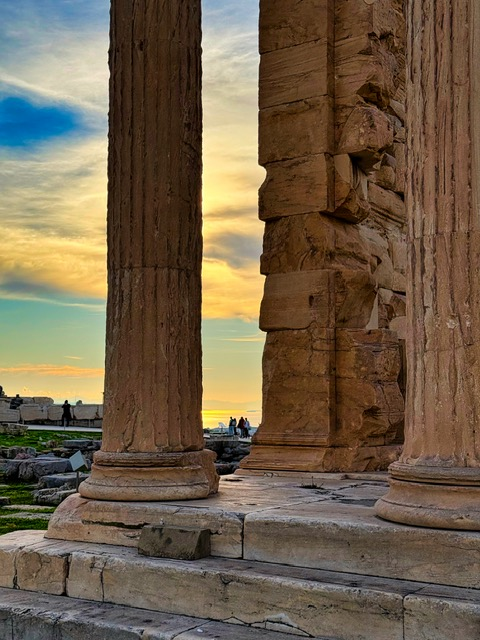
Small but mighty, this temple sits near the edge of the Acropolis and was dedicated to Athena as the goddess of victory. The views from this area alone are worth the climb.
The View: Athens at Your Feet
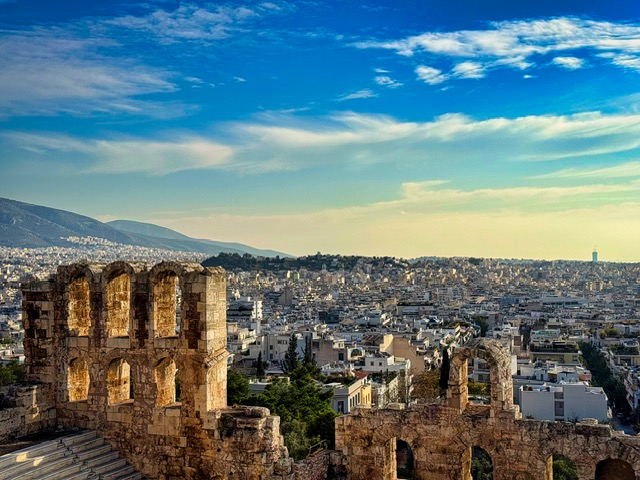
Once you reach the top, you’re rewarded with panoramic views of Athens stretching endlessly in every direction. White buildings, rolling hills, distant mountains, and the city humming far below—it’s the kind of view that makes you stop mid-sentence and just stare.
It also makes you realize why ancient Athenians thought this was the perfect spot for their gods.
Bringing the Ruins to Life: The Acropolis App
One of the coolest surprises? There’s an official Acropolis app, with the main standout being COSMOTE CHRONOS.
This app uses AR and VR technology to show ancient reconstructions of the buildings as they once stood. You can literally hold up your phone and see the Parthenon restored to its former glory. It also includes an AI-powered guide, which is especially helpful when you’re standing among ruins thinking, “Okay… what was this again?”
Highly recommend if you’re visiting independently.
How to Visit the Acropolis: Choose Your Style
There are a few ways to experience the Acropolis:
- Self-guided (with or without an app)
- Audio guide
- Booked guided tour
Because we’ve been studying the sites we visit as part of our homeschool units, we usually opt for self-guided. We like wandering at our own pace, stopping for questions, random history tangents, and occasional snack breaks. It works perfectly for us—and yes, it means our kid can casually drop Parthenon facts like it’s no big deal.
That said, self-guided doesn’t mean we don’t appreciate a good guide. My husband is famously known for slowly drifting toward nearby guided tours, pausing just long enough to absorb a few expert facts before casually wandering away again. He believes he’s incredibly sneaky. He is not. We let him live in that fantasy.
No matter how you plan to explore, we highly recommend buying your tickets in advance. Entry slots can sell out, and having tickets already sorted makes the whole experience feel calmer and more intentional—especially if you’re short on time or prone to “accidentally” joining someone else’s tour.
A Ride with a Legend (Literally)
On the way over, our Uber driver turned historian, telling us the legend of Athena and Poseidon’s battle for the city.
Poseidon struck the ground with his trident, creating a saltwater spring. Athena offered an olive tree—symbolizing peace, prosperity, and sustainability. The people chose wisely (sorry, Poseidon), and the city was named Athens.
History lesson and transportation? Five stars.
He also recommended Taverna Klimataria for an authentic Greek dinner.
He was not wrong.
Dinner Win: Taverna Klimataria
After a day of ruins and gods, we headed to Taverna Klimataria for dinner—and it delivered.
Very authentic Greek food.
Incredibly friendly staff.
Very much the kind of place where you linger longer than planned.
Simple, traditional dishes done right. Exactly what we wanted.
Getting to Athens: Airport Base Reality Check
We stayed near the airport, since we were only in Athens for one night and had an early flight the next morning. If you’re doing a quick stop like we were, staying close to the airport makes a lot of sense—and there are several solid hotel options in the area.
Airport-Area Hotel Options
- Comfort Stay Airport Studios (where we stayed) – Simple, clean, comfortable, and practical for a one-night stay. Exactly what we needed before an early departure.
- Sofitel Athens Airport – Located directly across from the terminal. Very convenient, very polished, and priced accordingly.
- Holiday Inn Athens Attica Ave – Airport West – Reliable, comfortable, and a popular choice for travelers with early flights.
- Peri’s Hotel – A smaller, well-reviewed hotel offering airport shuttle service and a quieter, more local feel.
None of these put you in the heart of Athens—but for a short stay, the trade-off in convenience is absolutely worth it.
Taxi / Uber
- ~40 minutes from the airport area to central Athens
- Door-to-door convenience
- Ideal if you’re short on time (like us)
Metro
- Cheaper and efficient
- Direct line from the airport to the city
- Takes longer overall, especially once you factor in walking and transfers
We planned to take the metro… but time said otherwise. Taxi won this round—and honestly, no regrets.
| Syps Family Athens Tip Box 🏛️ Book your tickets early (seriously—don’t wing this) 🏛️ Go near sunset / golden hour for magical photos 🏛️ Bring a travel day pack for essentials like your travel water bottle 🏛️ Good walking shoes (ancient marble is slippery and unforgiving) 🏛️ Download the COSMOTE CHRONOS app to see ancient reconstructions |
The Syps Survival Summary
Did we survive the battle between Athena and Poseidon?
Yes. Athena clearly had our backs. Poseidon mostly just brought the heat.
The Acropolis was warm but comfortable, uncrowded by Athens standards, awe-inspiring, humbling, and absolutely worth it. December turned out to be the sweet spot—clear skies, fewer people, and weather that felt downright ideal to a family used to Canadian winters.
Even with limited time, staying near the airport, and squeezing Athens into a whirlwind stop, the experience left a lasting impression.
Short trip. Massive history. Zero regrets.
And honestly? If you’re only going to see one thing in Athens—make it this hill.
Comments
One response to “The Best Thing to Do in Athens Is Standing on the Acropolis”
Memories of visiting Athens our first time came flooding back…. 12 years ago