If there’s one place in Sicily that truly knocked me off my sandals, it was the Valley of the Temples — or as I like to call it, “the land where my history-nerd dreams came true.”
Ever since I was a kid, I’ve wanted to stand among ancient Greek ruins, imagining philosophers debating, warriors striding past marble columns, and Zeus occasionally hurling a thunderbolt or two just to keep things interesting. So, when we finally made it to Valley of the Temples, I was thrilled. My daughter? Slightly less so.
“Do we really have to walk this whole way?” she sighed, eyeing the path that stretched far, far downhill. I cheerfully reminded her that what goes down must come up — but apparently, that wasn’t comforting.
To be fair, there is a tram that will take you back to the top for about €4 per person. Tempting, I admit — especially as the sun blazed overhead — but I refused on principle. We’d conquered every steep Tuscan village without mechanical aid, and I wasn’t about to let Zeus see me quit now. My daughter, however, was lobbying hard for that tram ride like her life depended on it.
After all the uphill climbs in Tuscany, though? This was easy peasy lemon squeezy.
Some links here are affiliate links. If you buy something, I might earn a small commission—thanks for supporting my blog! I only share products I use and stand behind.
A Little History Before We Trip Over It
The Valley of the Temples isn’t actually in a valley — it’s on a ridge overlooking Agrigento and the glittering Mediterranean coast. Built between 510 and 430 BC, these temples once formed part of the ancient city of Akragas, one of the most powerful Greek colonies in Sicily.
And honestly, it blows my mind that these structures are roughly 2,500 years old. Two and a half millennia — and they’re still standing there, majestic and defiant, while most of our modern buildings can barely survive a bad winter.
Back then, this place was all about showing off. Think of it as ancient Greece’s version of a luxury Instagram feed: massive temples, perfect symmetry, and sweeping coastal views designed to make visitors gasp (and probably bow).
Over time, Akragas fell to the Romans, who renamed it Agrigentum and adapted many of the temples for their own gods and rituals. Later, early Christians even converted some temples into churches — which is probably why they survived as well as they did. The Valley of the Temples has seen empires rise and fall, yet these stones remain, quietly holding centuries of stories.
Today, eight major temples survive in varying states of glory. Each one is dedicated to a different god — Concordia, Juno, Heracles, Zeus, and more. Standing among them, you can’t help but feel small. It’s impossible not to be in awe of what humans built 2,500 years ago — with no cranes, lasers, or Wi-Fi.
In the next section, I’ll walk you through five of the major temples — the ones that truly bring this ancient city back to life.
The Walk of the Gods (and One Whiny Teen)
1. Temple of Juno
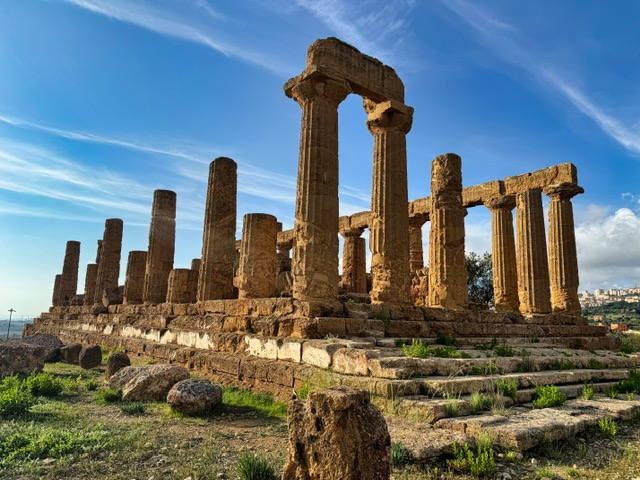
We started our walk at the Temple of Juno (Italian: Tempio di Giunone [Joo-NO-nay] ) — perched dramatically on a cliff edge, the kind of spot that screams, “I’m important, look at me!” Juno (or Hera, if you’re using her Greek name) was the goddess of marriage and childbirth, which probably explains why her temple sits slightly apart from the others. She likely needed the space — anyone married to Zeus definitely needed some breathing room.
2. Temple of Concordia
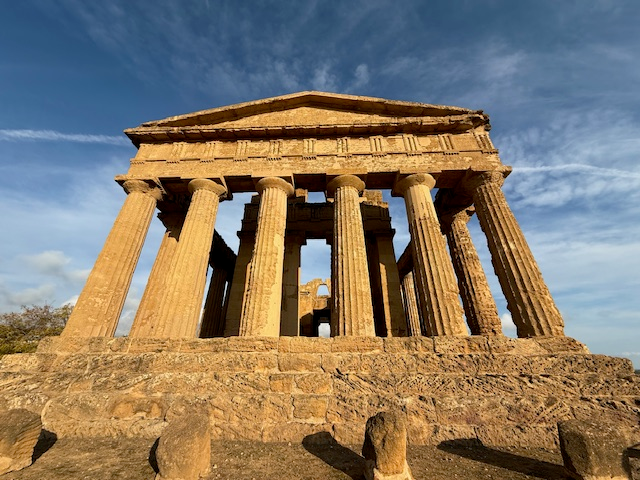
From there, we strolled down toward the Temple of Concordia (Italian: Tempio della Concordia [Con-KOR-dee-ah]), the undisputed star of the show. It’s so perfectly preserved it looks like it could’ve been built last week. That is, if last week involved hand-carving 34 Doric columns out of limestone. Dedicated to the Roman goddess of harmony, Concordia (Harmonia if using her Greek name), this temple has survived earthquakes, invasions, and countless tourists trying to get the perfect photo (myself included).
3. Temple of Hercules
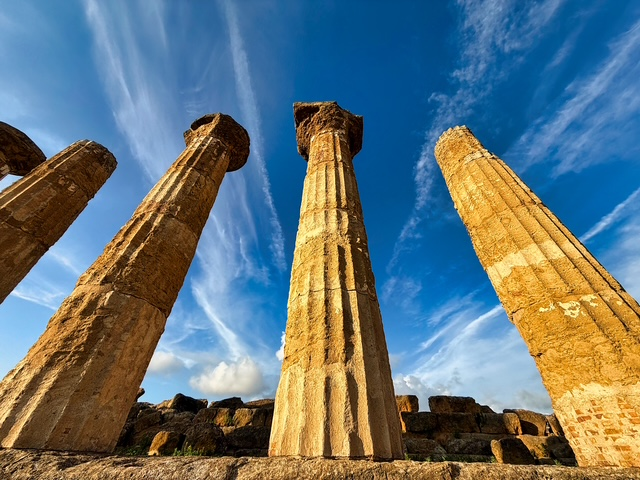
Next came the Temple of Hercules (Italian: Tempio di Ercole [EHR-coo-lay]) — a little more “ruin chic,” but still absolutely breathtaking. Hercules (or Herakles in Greek) was the muscle of the mythological world, famous for his twelve impossible labors, and his temple reflects that rugged energy. My daughter perked up here because it had fewer steps and a great photo op (priorities).
4. Temple of Zeus
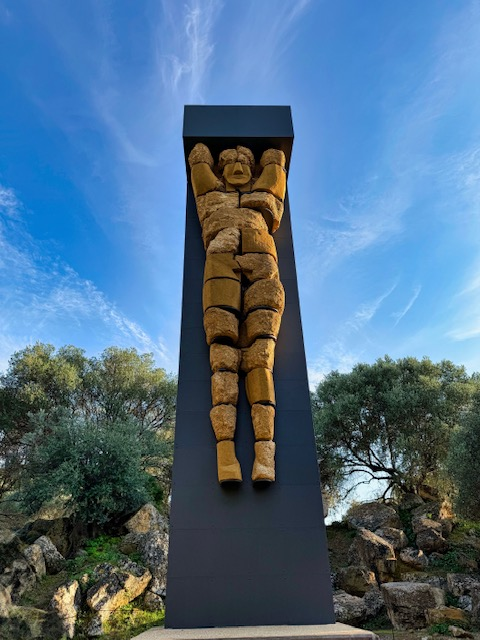
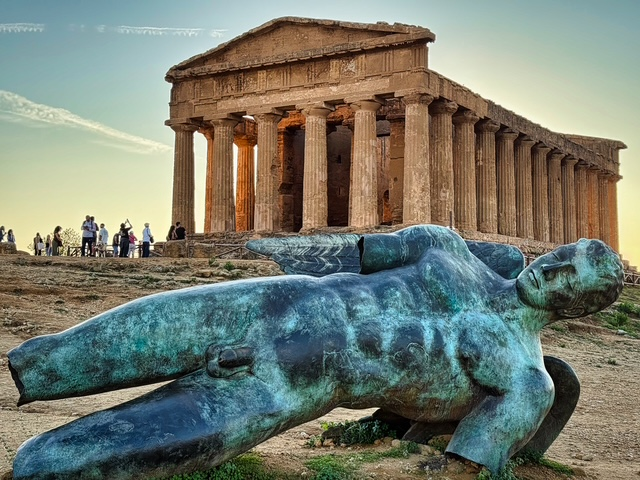
Then there’s the Temple of Zeus (Italian: Tempio di Zeus Olimpio [TEM-pyo dee ZAY-oos oh-LEEM-pyo]) — or what’s left of it. It’s basically giant, glorious rubble, but the kind of rubble that still manages to impress. Once one of the largest temples in the ancient Greek world, it was never fully completed, and centuries of earthquakes didn’t do it any favors. Among the fallen stones lies one of the site’s most fascinating features. A massive Telamon — a stone giant — once served as an architectural support figure. You can still see one of these huge, reclining statues on display, and it’s wild to imagine dozens of them once holding up the temple’s roof like mythological gym bros.
5. Temple of Dioscuri and Sanctuary of the Chthonic Deities
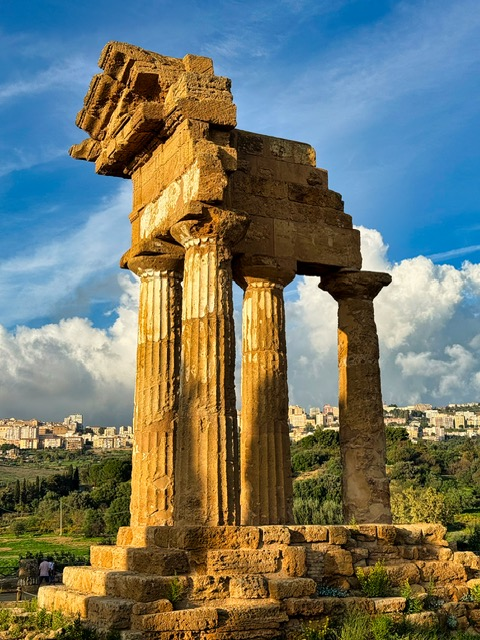
Finally, we reached the Temple of Dioscuri (Italian: Tempio dei Dioscuri [TEM-pyo day Dee-oh-SKOO-ree]) — one of the most photographed spots in the Valley. Only four columns remain, but they rise proudly against the Sicilian sky, a powerful symbol of brotherhood and resilience. The temple stands near the Sanctuary of the Chthonic Deities (Italian: Santuario delle Divinità Ctonie [San-twa-REE-oh DEL-le Dee-vee-nee-TAH CTO-nee-eh]) — a sacred area dedicated to the gods of the underworld and the fertility of the earth. Together, they create a fascinating contrast: the Dioscuri looking skyward toward the heavens, and the Chthonic sanctuary grounding the site in myth and mortality. It’s the perfect finale — a balance between life, death, and the enduring beauty of what humanity leaves behind.
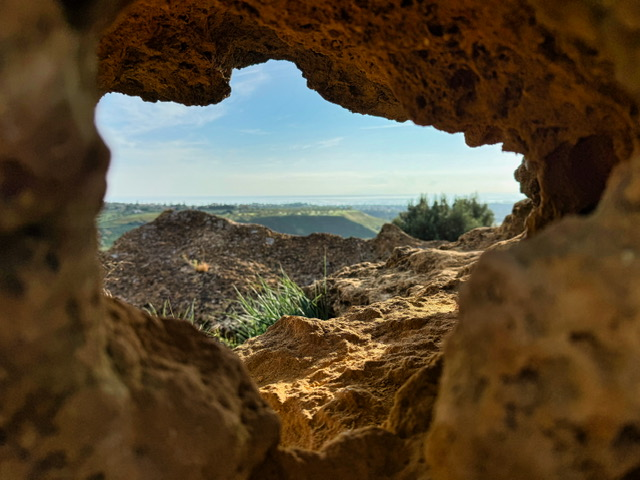
As we wandered through the temples, the views opened up. The Mediterranean glittered in the distance. Olive trees swayed in the breeze. Behind us, Agrigento’s skyline rose against the horizon. For a moment, it really did feel like we’d time-traveled. And despite the sun, the heat, and the one whiny teen (still petitioning for that €4 tram), I couldn’t stop smiling.
How to Get There
We visited the Valley of the Temples as a day trip, and it worked perfectly. Agrigento is well connected by both road and train, though if you have a rental car, driving is by far the most flexible (and the most scenic).
Here’s how to get there from the main Sicilian hubs:
- From Palermo: It’s about a 2-hour drive (130 km) via SS189/E933. The road winds through rolling hills and farmland. While it’s not the fastest highway in the world, it’s a beautiful drive. If you don’t want to drive, there’s also a direct train from Palermo Centrale to Agrigento Centrale that takes roughly 2 hours.
- From Catania: Expect around a 2-hour drive (165 km) via A19 and SS640. This route takes you through the heart of Sicily — olive groves, vineyards, and the occasional mountain view to keep you entertained.
- From Giardini Naxos (our base): About 2.5 hours (230 km) each way — but totally doable as a day trip. We left early, grabbed coffee to go, and made a few scenic stops along the way (because no road trip in Sicily should be rushed).
Where to Park
We parked at the Porta V Gate, near the eastern entrance. It’s super convenient if you’re starting at the Temple of Juno and working your way down. There’s another lot near the western end. If you don’t fancy the uphill return, grab a shuttle or taxi at the bottom.
Where to Stay Nearby
We visited as a day trip, but staying overnight is worth it if you can. Agrigento and the nearby countryside are magical after dark. The temples glow at sunset and light up beautifully at night.
Some great options if you decide to linger:
- Villa Athena – A 5-star hotel literally overlooking the temples. Unreal views and a once-in-a-lifetime setting.
- Colleverde Park Hotel – Lush gardens, a panoramic terrace, and a killer breakfast spread.
- B&B Le Casette di Lu – Budget-friendly and adorable, right in the heart of Agrigento.
But if you’re short on time (or based on the east coast like we were), a day trip is completely worth it — just plan an early start and bring snacks, because Zeus does not take kindly to hangry mortals.
| The Syps Family Valley of the Temples Tip Box ☀️Buy Tickets in Advance: Grab your skip-the-line Valley of the Temples tickets — trust me, you’ll thank yourself later when you breeze past the tour bus crowd. ☀️ Bring a Hat, Sunscreen & Water Bottle: It gets toasty out there — we used this collapsible water bottle and it totally saved the day. There’s not much shade once you’re among the ruins, so plan like a pro. We also each carried a packable travel backpack — it folds up small in your suitcase but was perfect for hauling water, snacks, and all the “just in case” stuff moms end up carrying anyway. ☀️ Wear Comfy Shoes: This is not the day to break in new sandals. The paths are uneven and dusty — think ancient rock meets modern tourist shuffle. I swear by Kizik sneakers — they slip on hands-free, look chic enough for photos, and don’t scream “I’ve been hiking since 9 a.m.” |
The Syps Survival Summary
Did we survive the wrath of Zeus? Barely — but we did.
We braved the sun, conquered the hills, and resisted the temptation to sacrifice our snacks to the gods.
Was it worth it? Absolutely. The Valley of the Temples isn’t just a highlight of Sicily — it’s one of those rare places that makes history feel alive.